
Aviation Parts Consolidation Is Accelerating. Communication Isn’t.
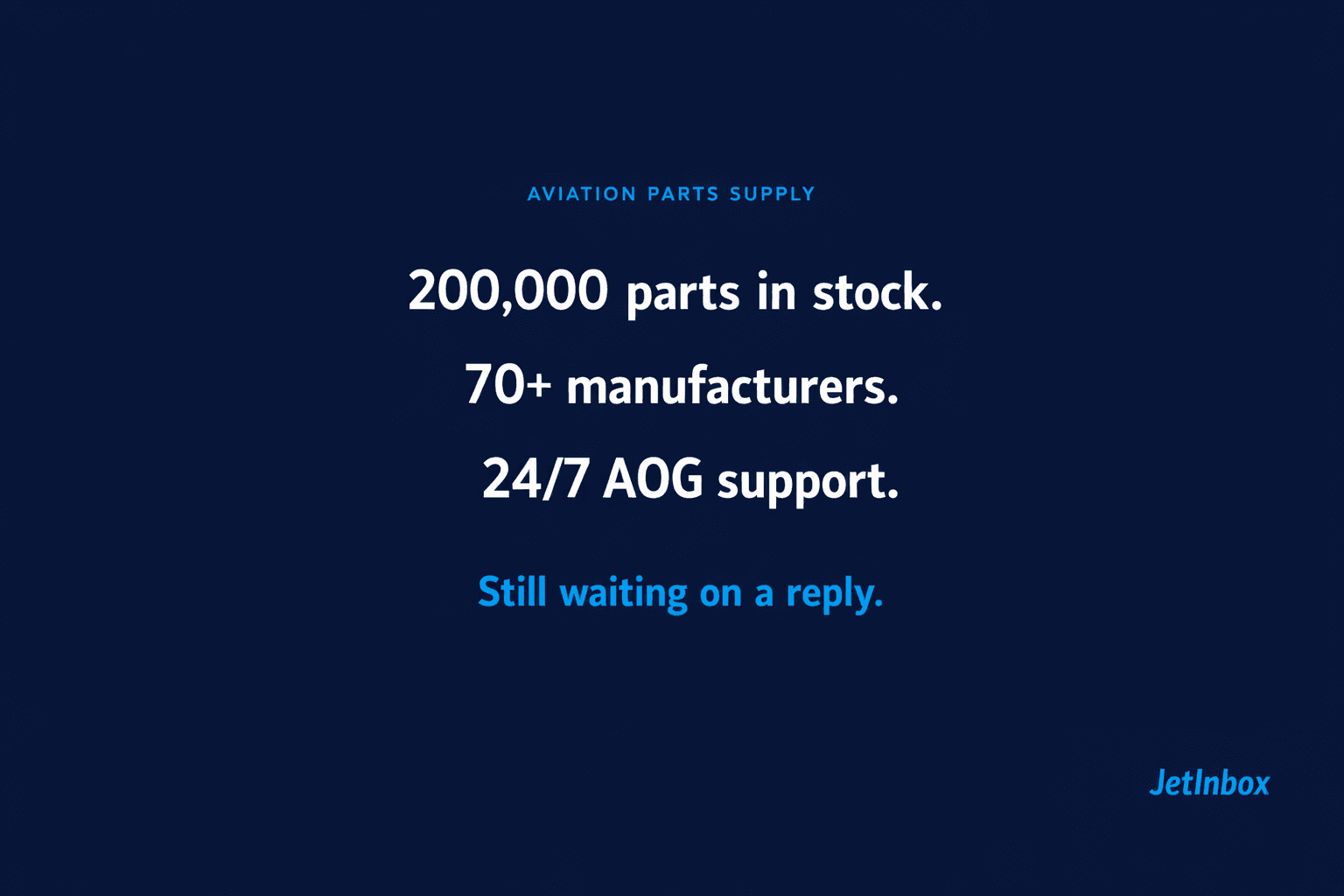
In early 2026, Chorus Aviation acquired Kadex Aero Supply — a premier Canadian aircraft parts distributor with over 200,000 parts in stock, relationships with more than 70 manufacturers, and 24/7 AOG support capabilities. It wasn’t an unusual deal. It was part of a pattern that’s been accelerating across the entire MRO aftermarket.
Private equity-led transactions accounted for nearly 20% of all M&A activity in the MRO sector in the first half of 2025. VSE Corporation agreed to acquire Precision Aviation Group for approximately $2 billion. AxioAero Group, backed by CORE Industrial Partners, acquired both a parts distributor and a component repair specialist to build an integrated platform. Bain Capital invested in MRO Holdings. Barnes Aerospace acquired ATI Forged Products’ East Hartford operations.
The aviation aftermarket is consolidating at a pace the industry hasn’t seen before. And the logic behind it is sound.
Why Consolidation Makes Sense
The fundamentals driving this wave are straightforward. Global passenger traffic reached an estimated 9.8 billion in 2025. Aircraft production is still below pre-pandemic levels, keeping older aircraft in service longer and pushing demand for aftermarket parts and maintenance higher. Engine durability issues — particularly with newer powerplants — are extending into 2027, further straining the parts supply chain.
The Aeronautical Repair Station Association estimates there are more than 4,000 FAA-certificated repair stations in the US alone, and 80% are small business entities. That fragmentation creates obvious inefficiency. Bigger platforms can offer broader inventory, faster logistics, better pricing, and more consistent service levels.
Chorus acquiring Kadex is a textbook example. Kadex brings a database of over 100,000 parts, established OEM relationships, and distribution infrastructure across Canada. Chorus gets to strengthen its MRO offering with a parts supply capability that would have taken years to build organically.
What Consolidation Doesn’t Fix
Here’s what none of these acquisitions address: the communication layer between the person who needs the part and the person who has it.
You can stock 200,000 parts across multiple warehouses. You can have relationships with 70 manufacturers. You can offer 24/7 AOG support. But if the AOG request lands in someone’s inbox at 2am missing the part number, condition requirement, and delivery location — none of that inventory matters until the follow-up thread resolves what should have been in the first email.
This isn’t a hypothetical scenario. It’s the daily reality for parts trading desks, AOG coordinators, and procurement teams across the industry. The first email is incomplete. The reply asks for clarification. The original sender is now handling a different request. The follow-up sits for an hour. The part that was needed four hours ago still hasn’t been confirmed.
Consolidation solves inventory. It solves logistics. It solves supplier relationships. It doesn’t solve the 45 minutes lost between a vague request and a clear one.
The Fragmentation Nobody’s Acquiring
The irony is that while the industry races to consolidate physical assets — parts inventories, repair stations, distribution networks — the communication infrastructure connecting all of these assets hasn’t changed in decades.
Magnetic MRO recently completed a two-way integration between SkySelect’s parts procurement platform and Swiss-AS AMOS maintenance software. That’s a step in the right direction — connecting procurement data to maintenance planning at the system level. But the vast majority of MRO communication still runs on unstructured email, phone calls, and WhatsApp messages between individuals who are under pressure and working across time zones.
Private equity firms are drawn to the MRO aftermarket because of its predictable, recurring revenue and clear scaling opportunities. They’re investing in platform roll-ups that combine component repair with parts distribution to create operational synergies. But those synergies only materialise if the coordination between the repair shop and the parts desk is fast, clear, and reliable.
Right now, for most operations, it isn’t.
Bigger Platforms, Same Bottleneck
The MRO M&A trend will continue through 2026 and beyond. The fundamentals support it. The fragmentation invites it. The investor appetite is clearly there.
But as these platforms grow — as they absorb more repair stations, more parts distributors, more regional capabilities — the volume of internal and external communication grows with them. More locations means more handoffs. More product lines means more quote requests. More customers means more AOG situations where speed of response determines whether you keep the account.
Scale amplifies whatever your communication layer already does. If it works well, scale makes it more efficient. If it doesn’t, scale makes the problem worse.
The industry is investing billions in physical consolidation. The communication between the people operating those consolidated platforms is still running on email threads and good intentions.
Where the Real Efficiency Gains Are
Aviation Week’s 2026 aftermarket predictions noted that MROs leveraging data analysis and AI will streamline turnaround times, manage supply chain constraints better, and bridge knowledge gaps for less experienced staff. That’s true — but it starts with the basics.
Before you can analyse data, you need data worth analysing. And right now, the richest source of operational data in most MRO operations — the email communication between teams, suppliers, and customers — is unstructured, unsearchable, and scattered across individual inboxes.
The parts consolidation trend is solving the supply side of the equation. Bigger inventories, better logistics, broader networks. That matters. But the demand side — the speed and clarity with which parts are requested, quoted, confirmed, and tracked — remains the bottleneck that no acquisition can fix.
You can acquire your way to a bigger parts catalogue. You can’t acquire your way to clearer communication.
Clearer emails. Fewer follow-ups. Less wasted time.
JetInbox is built for MRO, parts trading, leasing, and ops teams. Try it free for 60 days.